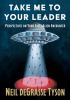
by Neil deGrasse Tyson
Kirkus Close encounters of the hilarious kind. Tyson—an astrophysicist and popular science communicator (Astrophysics for People in a Hurry, 2017), director of the Hayden Planetarium at the American Museum of Natural History, and host ofStarTalk—thinks that when it comes to aliens, we suffer from a lack of imagination. We share 25% of our genes with bananas—our last common ancestor having lived one and a half billion years ago (“a time in Earth’s tree of life that we could justifiably call ‘the banana split’”)—yet aliens, with whom we share no genes (who may not evenhave genes) are typically shown as looking far more similar to us than bananas do. Who’s to say they don’t look like octopuses or gaseous clouds? What if they’re the size of fleas? (Could a flea-sized intelligence build and operate an intergalactic spacecraft?) Probably they don’t have the classic ginormous eyes—if they have eyes at all—since big eyes leave less room for big brains, which, presumably, they have if they’ve made it to our corner of the Milky Way. They might not even be made of ordinary matter. If you meet an alien, Tyson suggests tossing a coin or other small object in their direction before shaking tentacles. “If, upon catching it, the Alien spontaneously explodes with the power of two hundred million sticks of dynamite, then it was made of antimatter. Otherwise, you’re good to go.” And that’s not even the most exotic possibility. “The coolest thing ever,” Tyson insists, “would be if Aliens occupied more spatial dimensions than we do.” They’d seem to appear as if from nowhere and would be able to see the inner contents of our bodies, no probes required. Writing in his usual breezy style, the author draws endless examples from science fiction and pop culture, his physics punctuated with all the trademarks his readers have come to expect: an unwavering belief in rationality, a disdain for belief in general, well-timed humor, the obligatory Pluto diss. His imaginings of the strangeness of alien life have the dizzying effect of making us look back at life on Earth through a kind of alien lens, through which our own bodies, customs, and concerns seem strange in their own right, right down to our obsession with aliens, conspiracy theories, and UFOs, all of which say more about us than them—about our yearning for something bigger, our curiosity about the cosmos, our questionable understanding of physics, and our front-facing eyes that so easily, and so wondrously, look up. A fun romp through the possibilities of alien lifeforms and the physics that might allow them to land in our backyards. Copyright © Kirkus Reviews, used with permission. Copyright © Kirkus Reviews, used with permission. |