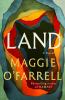
by Maggie O'Farrell
Kirkus A father and son stumble on an ancient Irish sacred site, with lasting consequences. It’s 1865 when the normally taciturn Tomás reels out of a mysterious wooded copse in rural Ireland, babbling nonstop. He and his 10-year-old son, Liam, have been surveying for the hated British, who need native speakers to learn place names and boundaries from the locals, then render them into English. But now, as he tells his pregnant wife, Phina, and daughters, Enda and Rose, back in Dublin, he plans to give up that job to make “a map of how this land really is, of how it has always been, of what lies beneath whatever order or disorder others might impose upon it.” Oh, and he has taken their life savings to lease land near the copse from a local aristocrat; they will live in a ruined cottage, abandoned years ago during the Great Hunger that emptied the Irish landscape and sent Tomás and Phina as children to a grim workhouse. This is the dramatic premise of O’Farrell’s evocative and impassioned 10th novel. After Tomás’ baffling announcement, the narrative rewinds some millennia to reveal the copse as the source of a spring with magical powers, in which a young girl finds a ring that belonged to her vanished father, the last of Ireland’s original inhabitants. Back in the 19th century, baby Eugene, born in the family’s new home, “is not as other children”; he never speaks and appears to have mystical understanding. He and his siblings, each a skillfully drawn individual, forge separate destinies over the following decades, embodying O’Farrell’s key themes: the conflict between Catholicism and ancient ways, the subjugation of women, the brutality of the English ruling class, the people’s connection to the land. A gruesome exorcism is the first of many disasters that befall the family—so many that only O’Farrell’s pungent reminders of Ireland’s long and tragic history keep the litany of sorrows from seeming excessive. The radiant closing pages offer a measure of relief from the generally dark tone. Steeped in Irish history and folklore, alive with a sense of wonder. Copyright © Kirkus Reviews, used with permission. Copyright © Kirkus Reviews, used with permission. Publishers Weekly O’Farrell (Hamnet) paints a devastating yet tender portrait of Irish history through the story of a Dublin family’s relocation to a western peninsula. In 1865, with resentment at British rule growing in Ireland, skilled draftsman Tomás travels with his 10-year-old son, Liam, from Dublin to the secluded outpost. His assignment is to map the area and to establish new English place-names to substitute for traditional Irish ones. But after Tomás discovers a mystical and secluded spring, he’s flooded by a newfound sense of purpose, which he attempts to explain to Liam: “My point is, my point is, my point is... that there needs to be a map of how this land really is.... And to do so would be an act of honour. Honour and resistance.” Liam is alarmed and confused by his taciturn father’s sudden torrent of words, and a local priest worries Tomás has been possessed by the devil. “That well... is a heathen place, pagan and godless,” the priest tells Tomás. Forever changed, Tomás moves his family to the peninsula, where older daughter Enda bristles at their isolation while Liam willfully turns toward God and away from his father. Meanwhile, younger daughter Rose longs for stability, and youngest child Eugene silently nurtures his own singular relationship to the land and its history. Mellifluous digressions spotlight the peninsula’s earlier settlers, such as a girl named Brith who walks in sealskin shoes on the same ground as Tomás and his family. It’s a stunning and gorgeous epic. (June) (c) Copyright PWxyz, LLC. All rights reserved Book list Maps are guides to regional geography; they can also be artifacts of colonialism or tools for revealing suppressed history. The latest by the author of Hamnet (2020) and The Marriage Portrait, (2022), a transfixing epic drawn from lore about her mapmaker ancestor, adds to O’Farrell’s reputation as a superb literary stylist. In 1865, with his wife and daughters in Dublin, Tomás works for Britain’s Ordnance Survey on a remote western Irish peninsula and quietly ensures that landmarks from the Great Hunger are documented. His 10-year-old son, Liam, unwillingly accompanies him. A mystical experience within an unmapped cluster of trees deeply affects the reserved Tomás, provoking difficult family upheavals. Through stories of love, tragedy, devotion, and the characters’ very human blind spots, we follow the multistranded plot forward from Ireland to Canada and India as well as backward into prehistory and Tomás’s repressed childhood memories. This wonderfully expansive yet intimate saga, which illustrates how individuals survive the devastating legacies of imperialism and religious control, offers a sense of empathetic harmony between author and subject. As relayed through beautiful passages about nature, the land abides as its occupants change, and the descriptions of music and its emotional impact soar. Readers will gain a whole new perspective on mapmaking with “its peculiar mix of science and storytelling, mathematics and artistry.” From Booklist, Copyright © American Library Association. Used with permission. Library Journal In this epic yet intimate portrait of Ireland, O'Farrell (Hamnet) uses one family to explore the island nation. In 1865, Tomás and his young son Liam work with the British Army to create a complete map of Ireland. While mapping a peninsula in the Atlantic, they find an undiscovered and mysterious copse of trees. This discovery will alter their lives. Tomás enters the copse to retrieve lost Liam and comes out mentally changed, to the extent that the local priest is called in to perform an exorcism. He is never the same man. He and Liam return to their family, but Tomás decides that he must move them all back to this peninsula. Interspersed with this family's story are time jumps to the future and even to the ancient past. All the narratives ultimately center on how the terrain itself has created and shaped Ireland. VERDICT O'Farrell's latest is highly recommended for all fiction collections. This lyrical and moving historical novel about Ireland and one family within its larger history will enchant her fans and anyone who likes family sagas.—Kristen Stewart (c) Copyright Library Journals LLC, a wholly owned subsidiary of Media Source, Inc. No redistribution permitted. |





