|
|
| ALA Best Books for Young Adults | 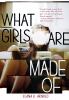 | | What Girls Are Made Of
by Arnold, Elana
School Library Journal Gr 10 Up-Nina has had a crush on Seth since fifth grade, but it wasn't until the summer after her 16th birthday that he finally acknowledged her feelings for him. Now, Nina will do whatever is necessary to maintain his affection. She is fully aware that all love comes with conditions; her mother, in particular, has made that very clear. But as the only child of dysfunctional parents, Nina craves the attention that Seth offers. Thoughts of him occupy her every waking hour, so when she unwittingly fails his unexpected test of her loyalty, she finds herself alone and adrift, especially after she makes a startling realization. When even her best friend fails to support her, Nina looks for help and solace in unlikely places, including at a dog shelter. In an afterword, Arnold explains that this story is the result of her anger at and complicity in the rules that society applies to girls. Her overarching theme is the fallacy of believing in unconditional love. The author presents a hopeful conclusion as Nina learns that self-love and fulfillment can be found through helping others. VERDICT Because of its complex symbolism and graphic imagery, this well-written novel is best suited to mature YA readers.-Cary Frostick, formerly at Mary Riley Styles Public Library, Falls Church, VA © Copyright 2017. Library Journals LLC, a wholly owned subsidiary of Media Source, Inc. No redistribution permitted. (c) Copyright Library Journals LLC, a wholly owned subsidiary of Media Source, Inc. No redistribution permitted. Book list Arnold's latest reveals how capricious first love and our trust in it can be. Nina, 16, is trying to make sense of the obsession she feels for her first boyfriend. I know it isn't okay to care this much about a boy. I know it's not feminist, or whatever, to make all my decisions based on what Seth would think, she chastises herself. Besides, she has grown up being told by her mother that all love has limits; it can't just surge forth unbridled. Then, just as Nina and Seth's relationship turns more intimate, he abandons her without explanation. In Nina's grief, she explores the origins of her longing for love, recalling a trip she took with her mother to Italy to study statues of saints, intertwining the saints' suffering with what she views as her own. Nina's honest musings about her vapid relationship with Seth, as well as the relationship of her fickle parents, demonstrate a keen sense of introspection and self-respect. Smart, true, and devastating, this is brutally, necessarily forthcoming about the crags of teen courtship.--Walters Wright, Lexi Copyright 2017 Booklist From Booklist, Copyright © American Library Association. Used with permission. |
| ALA Notable Books for Children | 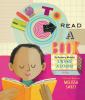 | | How to Read a Book
by Kwame Alexander
Book list Come, let your fingers wonder as they wander through this engaging and mesmerizing ode to reading. Beginning with the captivating front endpapers that contain a poem and letters of the alphabet, this title is a treat to ears and eyes with its lyrical language and visual metaphors. Newbery medalist Alexander instructs the reader on how to best go about devouring a book, likening it to peeling a piece of fruit and savoring its goodness. First, pick a comfortable place to sit, open a book, and open your mind to all that volume has to offer. Caldecott Honor Book illustrator Sweet's intricate collage art uses an array of materials, including text and images from Bambi, old book covers, watercolors, and gouache paintings. Popping pink, orange, yellow, and purple leap from the artwork, creating an energy and optimism that will keep readers glued to the pages. Books take on the shape of a bookmobile, a guitar, a record player, and a toaster that spews forth letters spelling Once upon a Time. One gatefold and a die-cut page continue to enthrall and expand enthusiasm. The author admonishes readers: Don't rush though: Your eyes need time to taste. Your soul needs room to bloom. Endnotes by the author and illustrator describe how they came to create this delightful and appealing instruction manual.HIGH-DEMAND BACKSTORY: Newbery medalist Alexander is popular across genres, and Caldecott Honoree Sweet's illustratrions enhance any project; together, they make an irresistible (and multi-award-winning) team--Maryann Owen Copyright 2019 Booklist From Booklist, Copyright © American Library Association. Used with permission. School Library Journal PreS-Gr 2—Award-winning poet Alexander compares reading a book to peeling the gentle skin of a clementine, digging in to its juiciness, enjoying it "piece by piece, part by part," until you can "watch a novel world unfurl right before your eyes." And who better to illustrate this delicious poem than Caldecott Honoree Sweet. The artwork is done in watercolor, gouache, mixed media, handmade and vintage papers, found objects including old book covers, and a paint can lid. Not a splash of color, a piece of paper, or a line is out of place. Starting with the initial collage that incorporates the building blocks of reading (the letters A to Z) and the lines from a poem by Nikki Giovanni that careful readers will have to pay attention to see, the tone is set. "So get/real cozy/between/the covers/And let your/fingers wonder/as they wander…" for there is much to relish in this poem and its exuberant images. "Squeeze/every morsel/of each plump line/until the last/drop of magic/drips from the infinite sky." The book includes a note from both the poet and the artist. VERDICT A beautiful book not to be rushed through, but to be enjoyed morsel by tasty morsel.—Lucia Acosta, Children's Literature Specialist, Princeton, NJ (c) Copyright Library Journals LLC, a wholly owned subsidiary of Media Source, Inc. No redistribution permitted. Kirkus A linguistic and visual feast awaits in Alexander and Sweet's debut collaboration.If the mechanics of deciphering words on a page is a well-covered topic, the orchestration of finding magic between pages is an art emphasized but unexplaineduntil now. First things are first: "find a treea black tupelo or dawn redwood will doand plant yourself." Once settled, take the book in hand and "dig your thumb at the bottom of each juicy section and pop the words out[then] // Squeeze every morsel of each plump line until the last drop of magic / drips from the infinite sky." Reading, captured here in both content and form, is hailed as the unassailably individual, creative act it is. The prosody and rhythm and multimodal sensuousness of Alexander's poetic text is made playfully material in Sweet's mixed-media collage-and-watercolor illustrations. Not only does the book explain how to read, but it also demonstrates the elegant and emotive chaos awaiting readers in an intricate partnership of text and image. Despite the engaging physicality of gatefolds and almost three-dimensional spreads, readers with lower contrast sensitivity or readers less experienced at differentiating shapes and letters may initially find some of the more complex collage spreads difficult to parse. Children depicted are typically kraft-paper brown.New readers will be eager to follow such unconventional instructions, and experienced readers will recognize every single step. (Picture book. 4-7) Copyright Kirkus Reviews, used with permission. Copyright © Kirkus Reviews, used with permission. Publishers Weekly Newbery Medalist Alexander's love poem to literacy conjures up startling, luscious images: to begin reading a book, he tells readers, "peel its gentle skin,/ like you would/ a clementine..../ Dig your thumb/ at the bottom/ of each juicy section." Caldecott Honor artist Sweet (Some Writer!) riffs on his verse, line by line, imbuing spreads with the feel of a continually evolving, handmade Valentine (as the copyright page pointedly notes, "no computer was used in making this art"). By turns dreamy and ecstatic, the images include portraits of blissed-out readers in a variety of settings, all constructed from swaths of saturated neon color and literary-themed ephemera (pages from Bambi are used throughout). One gatefold transforms a book into an electric orange triple-decker party bus, with 18 windows revealing allusive scenes made from cut paper and collage. The text, set in hand-lettered capitals, sprawls and stacks energetically as it proclaims its bibliophilia-sometimes whispering and cooing, sometimes shouting from the rooftops that it's got it bad for books. And why not? As Alexander writes, "Now, sleep./ dream./ hope./ (you never reach)/ the end." Ages 4-8. (June) © Copyright PWxyz, LLC. All rights reserved. (c) Copyright PWxyz, LLC. All rights reserved |
|