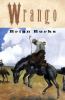
by Brian Burks
Book list Gr. 5^-8. Basing his story on the early years of African American cowboy George McJunkin, Burks spins a historical tale about a young man who yearns to ride the range. After he inadvertently squares off against the Klan to protect his father, George leaves town to save his own life. It isn't long before he lucks into a three-month stint as a horse wrangler on a cattle drive. By the time the cattle are in the boxcars, he has survived a rattlesnake bite, rescued an enemy from drowning, and helped catch a murderous thief. Supporting characters are not developed, and the events sound cliched. But Burks capably handles the goings on with honest dialogue and a wagonload of action--particularly in the scene describing the crossing of the treacherous Red River. An epilogue sketches in the real George's later years, but unfortunately, Burks never tells how much of the novel is actually fact. A glossary of cowboy slang is appended. --Randy Meyer From Booklist, Copyright © American Library Association. Used with permission. Library Journal Gr 4-8-A fictionalized biography of black cowboy George McJunkin's first cattle drive at age 16, Wrango is an affecting history lesson. Wrangling being the closest thing to an equal-opportunity vocation following the Civil War, it attracts George, who joins his mentor, Senor Valarde, on the Chisholm Trail herding cattle from Comanche, TX, to the rail yards in Abilene, KS. Racism surfaces-an ironically fortuitous run-in with the Klan in his south Texas hometown provides the catalyst George needs to cut the apron strings and begin his career as a cowboy; a jealous cowpuncher questions his place on the trail-but the rigors of the cattle drive generally supersede, or at least postpone, individual confrontations. Burks hints at McJunkin's intellectual potential through his desire to learn to read combined with an archaeological curiosity that would lead many years later to his discovery of the skeleton of "Folsom Man" in New Mexico. Indians, horse thieves, cholera, harsh weather, erratic terrain, and even herds of buffalo provide unifying adversaries for this mix of cowboys and vaqueros. Addenda include a frontispiece portrait of McJunkin on his horse taken when he was about 60-years-old, a map of the Chisholm Trail, and a brief glossary of cowboy/vaquero lingo. Fans of Denise Lewis Patrick's The Adventures of Midnight Son (Holt, 1995) will want to read this absorbing chronicle of a slightly older, equally introspective, although perhaps a bit cooler-headed, former slave who is determined to be his own man, proud and free.-John Sigwald, Unger Memorial Library, Plainview, TX (c) Copyright 2010. Library Journals LLC, a wholly owned subsidiary of Media Source, Inc. No redistribution permitted. (c) Copyright Library Journals LLC, a wholly owned subsidiary of Media Source, Inc. No redistribution permitted. Horn Book The youth of George McJunkin, a real-life African-American cowboy, is fictionalized in a novel that follows the teen as he leaves his home in post-Civil War Texas and joins a cattle drive. The writing is smooth, but the episodic story is predictable and doesn't offer much beyond the usual elements of the genre--a rattlesnake bite, a dangerous river crossing, and confrontations with horse thieves and Native Americans. Bib., glos. Reviewed by: pds (c) Copyright 2010. The Horn Book, Inc., a wholly owned subsidiary of Media Source, Inc. No redistribution permitted. All rights reserved. (c) Copyright The Horn Book, Inc., a wholly owned subsidiary of Media Source, Inc. No redistribution permitted. Kirkus From Burks (Walks Alone, 1998, etc.), the fact-based story of an ex-slave turned cowboy; the historical details are riveting but the characterizations and plotting are not. George McJunkin, a teenager recently freed from slavery, and trained to ride horses and rope by Senor Valarde, joins a cattle drive from Comanche, Texas, to Abilene, Kansas. Along the way he encounters prejudice, saves the life of one of his fellow drivers, is bitten by a rattlesnake, sees a lynching, begins to learn to read, and survives storm, stampede, and possibly hostile Indians to win the respect of his boss and crew. The particulars of life on the trail and the hardships of the job are fascinating; Burks paints a vivid picture of the tension, adventure, and tedium that are all part of the cowboy's lot. The motives ascribed to the characters, however, don't always make sense. Senor Valarde threatens to quit unless the trail boss, who already has a full crew, hires George; the trail boss not only has no hard feelings, but then fires the wrangler'or wrango'for drunkenness and gives the inexperienced George the job. A mean-spirited bigot, Charley, becomes abruptly faithful and kind after George saves his life, just one of the several instances in which the veracity in the setting and details is not matched by credible characters or plotting. (b&w photos, map, glossary, bibliography) (Fiction. 11-13) Copyright © Kirkus Reviews, used with permission. |