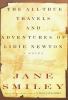
by Jane Smiley
Publishers Weekly An immensely appealing heroine, a historical setting conveyed with impressive fidelity and a charming and poignant love story make Smiley's (A Thousand Acres) new novel a sure candidate for bestseller longevity. Lidie Harkness, a spinster at 20, is an anomaly in 1850s Illinois. She has an independent mind, a sharp tongue and a backbone; she prefers to swim, shoot, ride and fish rather than spend a minute over the stove or with a darning needle. That makes her the perfect bride for Bostonian abolitionist Thomas Newton, who courts and marries her in a few days while enroute to Lawrence, K.T. (Kansas Territory), with a box of Sharps rifles. As the newlyweds gingerly come to know each other, they are plunged into the turmoil between pro-slavery Border Ruffians from Missouri and K.T. Free Staters, an increasingly savage conflict that presages the Civil War. Smiley evokes antebellum life with a depth of detail that easily equals Russell Banks's exploration of the same terrain in Cloudsplitter (Forecasts, Dec. 1, 1997). Her scenes of quotidian domesticity on the prairie are as engrossing as her evocation of riverboat travel on the Mississippi. Through an exquisite delineation of physical and social differences, she distinguishes and animates settings as diverse as Lawrence, Kansas City, St. Louis and New Orleans. As Lidie and Thomas experience privation, danger and the growing pleasures of emotional intimacy, and as tragedy strikes and Lidie pursues a perilous revenge, Smiley explores the complex moral issues of the time, paying acute attention to inbred attitudes on both sides of the slavery question. Propelled by Lidie's spirited voice, this narrative is packed with drama, irony, historical incident, moral ambiguities and the perception of human frailty. Much of its suspenseful momentum derives from Smiley's adherence to plausible reality: this is not a novel in which things necessarily turn out right for the heroine, for women in general, for blacks or for the righteous. Lidie's character deepens as she gains insight into the ambiguous and complex forces that propel men and women into love and compassion, hatred and violence. In the end, this novel performs all the functions of superior fiction: in reading one woman's moving story, we understand an historical epoch, the social and political conditions that produced it and the psychological, moral and economic motivations of the people who incited and endured its violent confrontations. 200,000 first printing; Random House audio. (Apr.) (c) Copyright PWxyz, LLC. All rights reserved (c) Copyright PWxyz, LLC. All rights reserved Library Journal A woman whose abolitionist husband is murdered in 1850s Kansas cuts her hair and tracks his killers to Missouri. A 200,000-copy first printing. (c) Copyright 2010. Library Journals LLC, a wholly owned subsidiary of Media Source, Inc. No redistribution permitted. (c) Copyright Library Journals LLC, a wholly owned subsidiary of Media Source, Inc. No redistribution permitted. Library Journal Seamlessly abridged, and beautifully read by Mare Winningham, this audio book will lull casual readers into stopping whatever they are doing and listening intently. The historical novel at its finest (LJ 4/1/98), this features a woman character at her strongest, calling to mind the works of Jane Austen. It's also Smiley's first venture into the 19th century. At the start of the novel, Lidie simply adopts her husband's abolitionist views; eventually, the young Lidie becomes a fervent believer, with the courage to challenge her husband and the social skill to damn the Kansas abolitionists in public. She presumptuously dons men's clothing and sets out alone to search for her husband's killers, but lets herself be tricked and encouraged by a slave woman looking only for escape. Smiley's skill with words has enabled her to produce three utterly different novels, and the recent movie success of A Thousand Acres will hopefully tempt listeners to pick this up. (Random House is also issuing an unabridged version.)?Rochelle Ratner, formerly with "Soho Weekly News," New York (c) Copyright 2010. Library Journals LLC, a wholly owned subsidiary of Media Source, Inc. No redistribution permitted. (c) Copyright Library Journals LLC, a wholly owned subsidiary of Media Source, Inc. No redistribution permitted. Kirkus Smiley (Moo, 1995, etc.) scales another peak with this bighearted and thoughtful picaresque novel set mostly in the Kansas Territory shortly before the Civil War. Narrator Lydia ``Lidie'' Harkness grows up in Quincy, Illinois, a tomboyish burden to her several older stepsisters, and leaps at the chance to marry Thomas Newton, a soft-spoken abolitionist who's bent on helping the ``free-staters'' dedicated to protecting Kansas against those who would make it a slave state. Missourians crossing the border wreak havoc on such hotbeds of abolitionist activity as Lawrence (near which the Newtons settle), and Thomas is soon one of many casualties. The ``disputacious'' Lidie?who'd become an even more ardent free-stater than her husband?thereafter sets off on an eastward journey seeking revenge and finding instead an unexpected empowerment. Her adventures while disguised as a boy (``Lyman Arquette''), reporting for a proslavery newspaper, and helping a woman escape a plantation are recounted with a zest and specificity that beg comparison with Mark Twain's portrayal of the immortal Huck Finn. Lidie is a splendid creation: a forthright, intelligent woman who recognizes, long before she can articulate it, the kinship of women relegated to submissive housewifery with people who are literally bought and sold?and who acts to change things. Surrounding her are such agreeable supporting characters as silver- tongued, slave-owning widower ``Papa'' Day, ``radical'' Louisa Bisket (who considers corsets symbolic of male tyranny), and the superbly unctuous David Graves, blithely unimpeded by loyalties of any variety (``My principle is to serve both sides, to have no sides, indeed, but to serve all!''). Not all of Smiley's obviously scrupulous research is transmitted successfully into story?Lidie does mull over political and social complexities a mite compulsively. Little else goes awry, though, in the richly entertaining saga of a woman who might have been well matched with Thomas Berger's ``Little Big Man,'' and whom Huck Finn would have been proud to claim as his big sister. (First printing of 200,000) Copyright © Kirkus Reviews, used with permission. Book list Each of Smiley's three most recent novels is a radical departure from the last. She dramatized midwestern farm life in A Thousand Acres (1991), satirized academia in Moo (1995), and now brings her acumen and magic to historical fiction, transporting her expectant readers back in time to the frenetic years leading up to the Civil War. The story begins in Quincy, Illinois, where 20-year-old Lidie has to decide what to do with her life. Tall, plain, athletic, she has zero tolerance for the severe limitations imposed on her sex and is extremely skeptical of marriage, but when Thomas Newton, a self-possessed New England abolitionist, comes to town on his way out to the Kansas Territory, she responds without hesitation to his suit. Thrilled to be off on an adventure, she doesn't stop to wonder why her husband values her fearlessness and skill with horse and gun over her feminine wiles, but she finds out soon enough. Kansas is a rough and violent place, and abolitionists are a despised and endangered breed. Their life is one of deprivation and danger, but Lidie, an entrancing narrator, finds marriage every bit as challenging as poverty, winter, and war. Tragically, she doesn't get a chance to learn what love really is because Thomas is murdered within the year. A bit mad with grief and determined to exact revenge, Lidie disguises herself as a man, but she soon realizes that few things are as simple as fanatics make them out to be. Gloriously detailed and brilliantly told, this is a hugely entertaining, illuminating, and sagacious vision of a time of profound moral and political conflict, and of one woman's coming to terms with the perilous, maddening, and precious world. --Donna Seaman From Booklist, Copyright © American Library Association. Used with permission. |